



This English translation is provided for your convenience. Only the German version is legally binding.
Information pursuant to Section 24 of the German Battery Law Implementation Act (Batterierecht-Durchführungsgesetz, BattDG) and Regulation (EU) 2023/1542
X-HUNTER does not sell batteries individually. Batteries or rechargeable batteries are only occasionally built into small electronic devices such as sighting optics by the manufacturer or supplied with them in the original packaging. In accordance with the German Battery Law Implementation Act (BattDG) and the EU Batteries Regulation (EU) 2023/1542, we inform you as follows:
Batteries and rechargeable batteries must not be disposed of with household waste; you are legally obliged to return used batteries and rechargeable batteries. Waste batteries may contain harmful substances which, if not stored or disposed of properly, may damage the environment or your health. However, batteries also contain important raw materials such as iron, zinc, manganese or nickel and can be recycled.
After use, you can return the batteries free of charge to a municipal collection point or to a local retailer. You can send suitable waste portable batteries back to us for proper disposal. Acceptance is free of charge; you bear the postage costs of this return by post. Statutory rights to free-of-charge return options remain unaffected. Please send a sufficiently stamped parcel marked with the keyword "Batterieentsorgung" (battery disposal) to: X-Hunter, Satower Weg 9a, D-24357 Fleckeby. Please observe the applicable transport regulations and the carrier's acceptance conditions, in particular for lithium batteries. Damaged or defective lithium batteries must not be handed in for normal parcel shipping without having been checked.
The statutory take-back obligation of retailers covers waste batteries of the battery categories which the retailer offers or has offered as new batteries in its range, in quantities that private end users usually dispose of. It is not tied to a new purchase or to a previous purchase from the same retailer. Devices with waste batteries still built in must be returned via the take-back system for waste electrical equipment.
The symbol of the crossed-out wheeled bin on the battery or, where applicable, its packaging means that waste batteries must be collected separately from household waste. Where the relevant content thresholds are exceeded, the chemical symbol of the metal concerned is additionally indicated: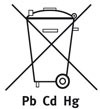
Pb = battery contains more than 0.004% lead by mass.
Cd = battery contains more than 0.002% cadmium by mass.
Hg = older marking for batteries containing more than 0.0005% mercury by mass.
Information pursuant to Sections 10 and 18 of the German Electrical and Electronic Equipment Act (Elektro- und Elektronikgerätegesetz, ElektroG)
In accordance with the German Act on the Placing on the Market, Take-Back and Environmentally Sound Disposal of Electrical and Electronic Equipment (ElektroG), we inform private households of the following:
Electrical and electronic equipment that has become waste is considered waste equipment. Owners of waste equipment must send it for collection separate from unsorted municipal waste. Waste equipment must therefore not be disposed of with household waste; for this reason it is marked with the symbol of a crossed-out wheeled bin shown here.
Before handing it in at a collection point, owners of waste equipment must separate from the waste equipment, without destroying them, any waste batteries and waste accumulators not enclosed by the waste equipment, as well as any lamps that can be removed without being destroyed. This does not apply where waste equipment is separated for preparation for re-use in accordance with Section 14(4) sentence 4 or Section 14(5) sentences 2 and 3 ElektroG.
Owners of waste equipment from private households can hand it in at the collection points of the public waste management authorities or at the take-back points set up by manufacturers or distributors within the meaning of the ElektroG. Information on return options and the return point finder of Stiftung ear can be found here: Disposing of waste electrical equipment correctly.
Waste equipment, in particular information technology and telecommunications equipment such as computers and smartphones, may contain personal data. You yourself are responsible for deleting such data on the waste equipment before disposing of it.